

28 Aug : Leadership Development Strategies for Long-Term Business Success

Leadership development strategies directly determine long-term business success, and the data on this is no longer ambiguous — yet 83% of organisations still struggle to develop leaders at every level, which is exactly the gap I see forcing clients into reactive, expensive external searches that a stronger internal pipeline could have avoided.
“Every emergency search I’ve run has the same backstory: leadership development that should have started three years earlier, didn’t.”
A family-run manufacturing client once called us in a genuine crisis — their CEO had an unplanned medical exit, and there was no internal successor within two levels of readiness. We filled the seat externally, but the client’s own board later admitted the real failure predated the crisis by years: no structured leadership pipeline had ever been built. That conversation reshaped how we now advise clients on development, not just placement.
What This Blog Covers
1. Why leadership development directly drives long-term business success
2. The most effective leadership development strategies for 2026
3. Why most leadership development programmes underperform
4. How succession planning should fit into development strategy
5. How Indian enterprises should structure this investment
Why Does Leadership Development Directly Drive Long-Term Business Success?
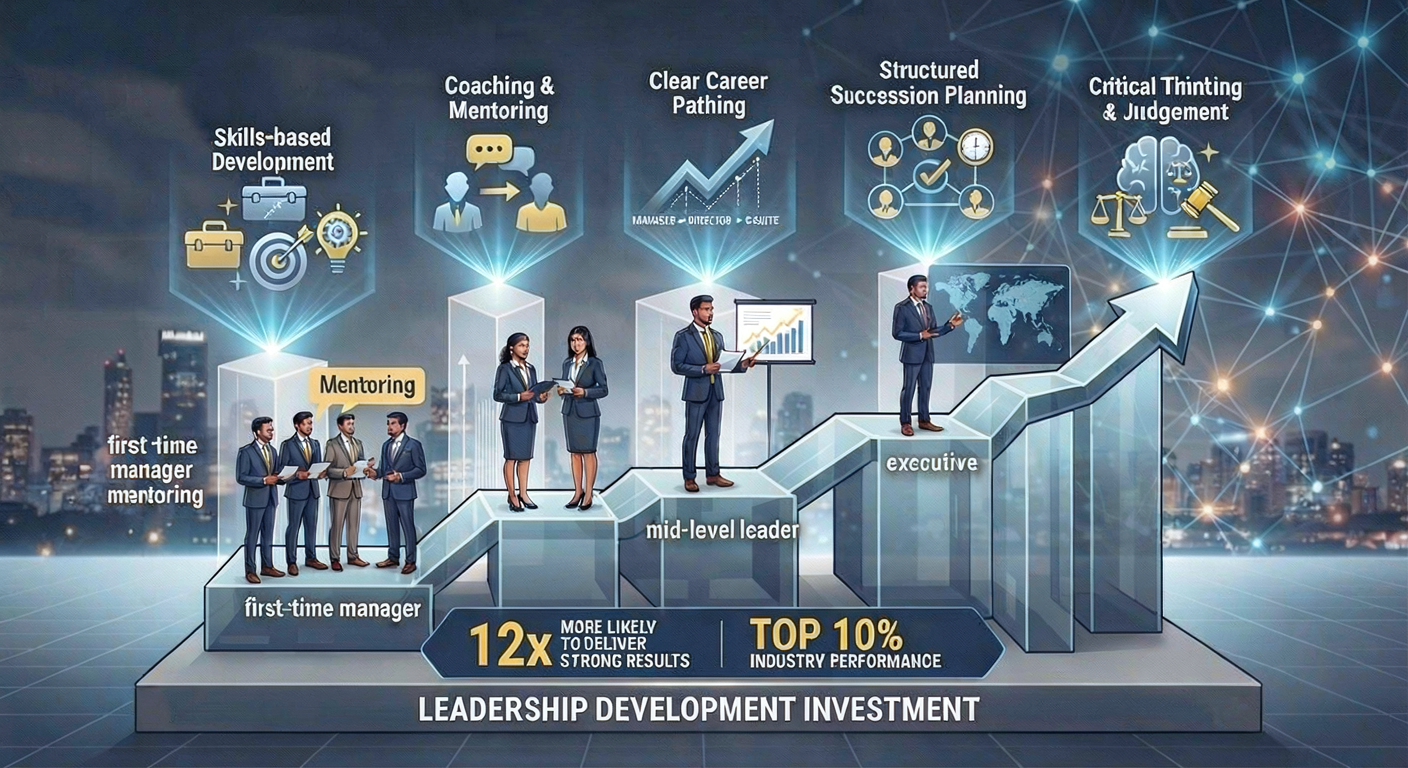
Leadership development coaching program directly drives long-term business success because organisations with strong leadership training are twelve times more likely to deliver strong business results, and 83% of businesses now recognise it as a critical factor in achieving that success. This isn’t a soft HR metric — it shows up in financial performance data directly.
Companies offering leadership development at all levels of leadership are more than twice as likely to rank in the top 10% of their industry’s financial performance, compared to those offering it at just one or two leadership levels.
What Are the Most Effective Leadership Development Strategies for 2026?
The most effective leadership development strategies for 2026 integrate learning directly into live business work — coaching and peer feedback delivered while a leader handles real initiatives — rather than relying on periodic, standalone training sessions disconnected from actual decisions.
1. Skills-based development tied to specific, current business needs, not generic competency frameworks
2. Coaching and mentoring embedded into live projects, not scheduled separately from the work
3. Clear career pathing, since high-potential leaders with defined development plans are 2.4 times more likely to stay with their organisation
4. Structured succession planning built well ahead of an actual vacancy
5. Deliberate focus on critical thinking and judgement, now ranked among the highest-demand leadership capabilities — see our full breakdown of executive leadership skills every business leader needs.
Why Do Most Leadership Development Programmes Underperform?
Most leadership development programmes underperform because organisations increase spending without addressing the underlying gap — development still concentrated at one or two senior levels, disconnected from actual business challenges, and treated as a one-time event rather than continuous practice. 56% of organisations have increased their leadership development budget in the past year, yet results haven’t scaled proportionally.
The pattern I see most often in client conversations: leadership development gets funded generously at the top two tiers and skipped almost entirely for first-time people managers — precisely the level where most leadership habits, good or bad, actually get formed.
Dimension | Reactive Hiring | Proactive Development |
Trigger | A vacancy or crisis | Ongoing, years in advance |
Cost | Higher — external search, ramp-up time | Lower — spread over time |
Speed to fill | Slower, under pressure | Faster, successor already ready |
Risk | Cultural and strategic mismatch | Known fit, tested internally |
Retention impact | Neutral to negative | Positive — high-potentials stay longer |
Business continuity | Disrupted during transition | Largely preserved |
How Should Succession Planning Fit Into Leadership Development?
Succession planning should be treated as the natural output of ongoing leadership development, not a separate, occasional exercise triggered only when a senior departure becomes imminent. A structured pipeline built years in advance turns a potential crisis — like the one in our manufacturing client’s story — into a smooth, low-risk transition instead.
This is also where AI is starting to change the conversation directly: over half of organisations now expect their leaders to integrate AI into strategic decision-making, which means succession planning increasingly needs to account for AI fluency as a criterion, not just traditional leadership readiness.
How Should Indian Enterprises Structure Their Leadership Development Investment?
Indian enterprises, particularly promoter-led and family businesses, should structure leadership development investment around building genuine bench strength at least two levels below the C-suite, rather than concentrating it solely at the top. As we cover in our piece on the future of executive leadership, this gap is widening as enterprise-wide, AI-aware leadership becomes the norm rather than the exception.
The businesses moving fastest on this pair external executive search with a parallel internal development strategy, so that every senior search also strengthens the pipeline for the next one — rather than treating each vacancy as an isolated, reactive event.
Leadership Pipeline Checklist
1. A named potential successor identified at least two levels below every senior role, ideally someone whose leadership personality traits complement rather than duplicate the existing team’s profile.
2. Structured exposure to enterprise-level decisions before someone is formally in line for a C-suite seat
3. Coaching and mentoring embedded into live projects, not scheduled as separate training
4. Development investment reaching first-time managers, not just the top two tiers
5. AI fluency assessed as part of readiness, alongside traditional leadership criteria
6. A succession review cadence that happens annually, not only when a vacancy appears
Closing Thought
The businesses least exposed to leadership risk aren’t the ones with the strongest current C-suite — they’re the ones with the deepest bench three levels down. That depth doesn’t happen by accident; it’s the direct result of deliberate, sustained investment made years before anyone needed it.
Whether you’re strengthening your leadership pipeline, planning for succession, or looking for the right leadership talent, Cornerstone’s executive search services can help you build a stronger leadership team for the future.
Happy to discuss your leadership pipeline or succession strategy. Reach out to me directly at vijay@cornerstone.co.in.
Frequently Asked Question's
1. What is the strongest evidence that leadership development affects business performance?
Organisations with strong leadership training programmes are twelve times more likely to achieve strong business results, and those offering development at all leadership levels are more than twice as likely to be top financial performers in their industry.
2. Why do many leadership development budgets grow without matching results?
Because spending often concentrates at senior levels while first-time managers — where leadership habits actually form — receive little structured development at all.
3. How far in advance should succession planning start?
Ideally several years before an anticipated departure, so potential successors have real time to build enterprise-level experience rather than being fast-tracked reactively.
4. Does leadership development actually improve retention?
Yes. High-potential leaders with clear career and development plans are 2.4 times more likely to say they intend to stay with their organisation.
5. Should AI fluency now be part of leadership development programmes?
Increasingly yes. More than half of organisations now expect leaders to integrate AI into strategic decision-making, making it a relevant development priority rather than a specialist concern.
6. How does executive search connect to leadership development strategy?
A well-designed search doesn’t just fill a single seat — it should also inform how a business strengthens its internal pipeline, so the next similar vacancy is less dependent on an external search.
