

30 Aug : Executive Leadership Skills Every Business Leader Needs in 2026

Executive leadership skills that mattered five years ago aren’t sufficient on their own in 2026 — the bar has moved, and it’s moved fastest in exactly the areas AI cannot replicate. I see this directly in how client briefs read today: technical credentials still matter, but they’re no longer the deciding factor in a senior hire. This is also why executive coaching India has become increasingly relevant for leaders looking to strengthen the skills required to lead effectively in a rapidly changing business environment.
“The leaders who struggle in 2026 aren’t the ones who lack expertise. They’re the ones who never updated what expertise is supposed to mean.”
A board I advised recently turned down a highly credentialed CEO candidate after a single reference check surfaced a pattern: strong on strategy, weak on reading the room during a crisis. Their exact feedback was that the candidate could present a brilliant plan but couldn’t adapt it live when the situation changed mid-conversation. That single gap cost him the role. It’s a gap I’m seeing eliminate strong candidates more often than any technical shortfall.
What This Blog Covers
1. Which leadership skills genuinely matter for 2026
2. Why strategic thinking has become a baseline, not a differentiator
3. How much emotional intelligence weighs at the executive level
4. Why AI fluency now belongs on every leader’s skill list
5. What psychological safety has to do with leadership effectiveness
6. How leaders can build these skills deliberately, not by accident
What Leadership Skills Actually Matter for Business Leaders in 2026?
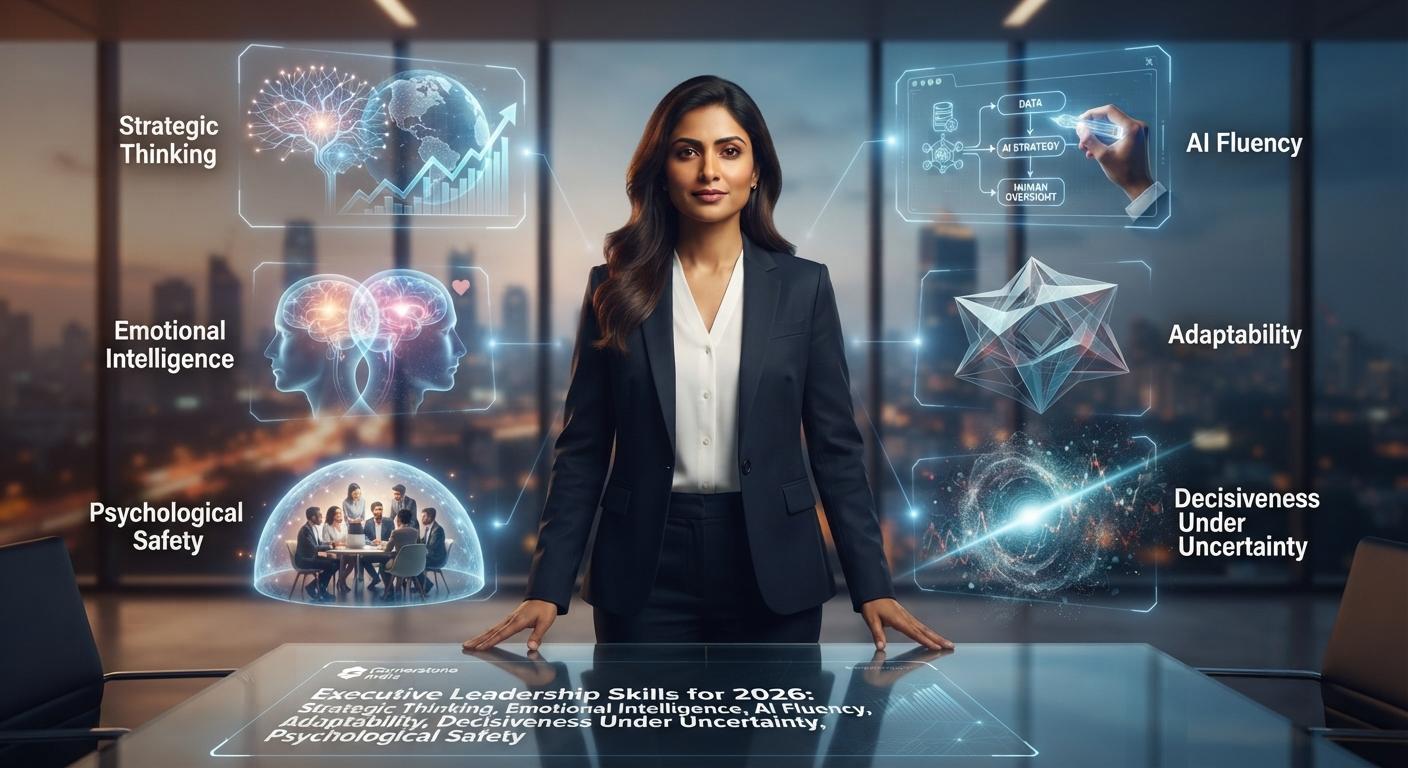
The leadership skills that matter most in 2026 are strategic thinking, emotional intelligence, AI fluency, adaptability, decisiveness under uncertainty, and the ability to build psychological safety — a mix of business intelligence and people intelligence, not either alone. The World Economic Forum’s Future of Jobs Report ranks leadership and social influence as a core skill by 61% of employers looking ahead to 2030, alongside an expectation that 39% of workers’ core skills will change substantially by then.
Source: World Economic Forum, Future of Jobs Report 2025, cited in Growthspace and Rowan University (2026).
What follows is a closer look at six of these, each with a fact grounding why it matters now, and a reflection point worth sitting with honestly.
1. Strategic Thinking
Strategic thinking — the ability to balance long-term vision with short-term execution — has moved from an executive differentiator to a baseline expectation across leadership levels. 90% of business leaders now consider it essential for hiring and growth decisions.
Source: NTUC LearningHub, cited in IMD
Reflection point: Can your direct reports clearly articulate how their weekly priorities connect to your three-year plan? If not, the strategy may be clear to you and invisible to them.
2.Emotional Intelligence
Emotional intelligence — recognising and regulating your own emotions while reading and responding to others’ — directly shapes communication, conflict resolution, and retention at the executive level. It’s closely tied to underlying leadership personality traits like emotional steadiness, which research increasingly links to team performance.
Reflection point: The last time a team member disagreed with you in a meeting, did their tone change afterward for the rest of the discussion? That shift is usually the clearest signal of your emotional intelligence in practice, not your own sense of how you handled it.
3. AI Fluency
AI fluency — understanding what AI can and cannot decide, and where it changes your business model — is now a core leadership skill rather than a technology function’s concern. CEO ownership of AI strategy has roughly doubled year-on-year, with nearly three-quarters of CEOs describing themselves as their organisation’s primary decision-maker on AI.
Reflection point: If your team proposed an AI-driven change to a core process tomorrow, could you evaluate the trade-offs yourself, or would you need someone else in the room to translate it for you?
4. Adaptability
Adaptability — the capacity to adjust direction as conditions shift — has become one of the most cited leadership skills of the decade, driven by geopolitical volatility, AI-driven disruption, and continuously shifting workforce expectations.
Reflection point: Think of the last major plan you had to abandon mid-execution. How long did it take you to communicate the change to your team — and did they hear it from you first, or from someone else?
5. Decisiveness Under Uncertainty
Decisiveness under uncertainty — making a well-judged call without complete information — increasingly separates effective leaders from those who stall. Analysis paralysis is often driven by fear of being wrong rather than a genuine lack of information, and it costs organisations real momentum.
Reflection point: What’s the longest you’ve sat on a decision this year that you already had enough information to make? What were you actually waiting for?
6. Psychological Safety
Building psychological safety — creating a team environment where people can raise concerns and take risks without fear — is one of the strongest predictors of team performance available to leaders today. Employees who report feeling psychologically safe are 31% more likely to be high performers than those who don’t.
Reflection point: When was the last time someone on your team pushed back on a decision you’d already made — and changed your mind? If you can’t recall one recently, that silence is worth investigating.
Why Has Strategic Thinking Become a Baseline Expectation?
Strategic thinking has become baseline because organisations can no longer afford leaders who execute well but can’t connect their decisions to a broader direction — the pace of change simply punishes leaders who operate purely tactically. This is precisely why we now probe strategic reasoning explicitly in senior interviews, rather than assuming it from a strong operational track record.
How Important Is Emotional Intelligence at the Executive Level?
Emotional intelligence is now considered one of the strongest predictors of executive effectiveness, because it directly shapes trust, retention, and how well a leader navigates conflict at scale. Technical brilliance without it tends to produce short leadership tenures, not long ones — a pattern I’ve watched play out repeatedly in senior placements.
Why Does AI Fluency Now Belong on Every Leader’s Skill List?
AI fluency belongs on every leader’s skill list because AI-driven change is being cited by the large majority of employers as the most critical driver of business transformation right now, which means every function — not just technology — needs leaders capable of evaluating AI-related trade-offs directly.
What Role Does Psychological Safety Play in Leadership Effectiveness?
Psychological safety plays a foundational role in leadership effectiveness because it determines whether a leader actually hears the truth from their team early enough to act on it. Leaders who build it consistently outperform those who don’t, not through inspiration alone, but because problems surface sooner and get solved faster.
How Should Leaders Build These Skills Deliberately?
Leaders should build these skills deliberately through structured feedback, leadership development coaching, targeted coaching tied to specific gaps, and honest self-assessment — not by assuming seniority alone develops them. For a fuller framework on this, see our guide to leadership development strategies for long-term business success.
1. Start with a gap analysis tied to actual business priorities, not a generic skills list
2. Prioritise coaching for behaviour-change skills — conflict, presence, difficult feedback — over one-time training
3. Ask your team directly, not just your peers, where your blind spots show up
Closing Thought
None of these six skills are new concepts. What’s changed is how unforgiving the environment has become toward leaders who are strong in only one or two of them. The leaders thriving in 2026 are the ones treating this as a deliberate development agenda, using executive search services where needed, rather than assuming seniority handles development on its own.
Happy to discuss leadership capability for your senior team or your own development. Reach out to me directly at vijay@cornerstone.co.in.
Frequently Asked Question's
1. What is the single most important leadership skill for 2026?
There isn’t one — the strongest leaders combine strategic thinking, emotional intelligence, and AI fluency together. Leaning heavily on only one leaves a visible gap.
2. Can these skills be developed, or are they mostly innate?
They can be developed, particularly with structured coaching and deliberate practice. Behaviour-based skills like emotional intelligence and psychological safety-building respond especially well to ongoing coaching rather than one-off training.
3. Why is AI fluency now expected outside of technology leadership roles?
Because AI-driven change is reshaping decisions across every function, not just technology, and leaders across the business are increasingly expected to evaluate AI-related trade-offs directly.
4. How does executive search assess these skills in senior candidates?
Through structured behavioural interviews and reference checks that probe how a candidate has actually handled ambiguity, conflict, and change — not just what they accomplished on paper.
5. Is psychological safety the leader's responsibility alone?
Largely, yes, at least in setting the tone. Team culture tends to mirror what leaders visibly reward or punish when someone raises a concern or pushes back.
6. What's the fastest way for a leader to identify their own biggest skill gap?
Direct, structured feedback from their own team, combined with an honest look at where decisions have stalled or teams have quietly disengaged.
