

13 Apr : Talent Assessment Tools That Actually Work for Senior Roles
Identifying the right succession candidates is only half the challenge. Evaluating them with rigour and objectivity is the other — and it is where most organisations fall short, even for executive search firms in india that operate at the highest levels of leadership hiring. Earlier in this series, we covered how to spot future leaders internally and what best-practice CEO succession looks like. This blog goes one layer deeper: at the C-suite level, most assessment tools are designed for a problem they cannot fully solve. Here is what actually works, what is overused, and how to build an assessment architecture that produces genuinely useful insight rather than reassuring data.
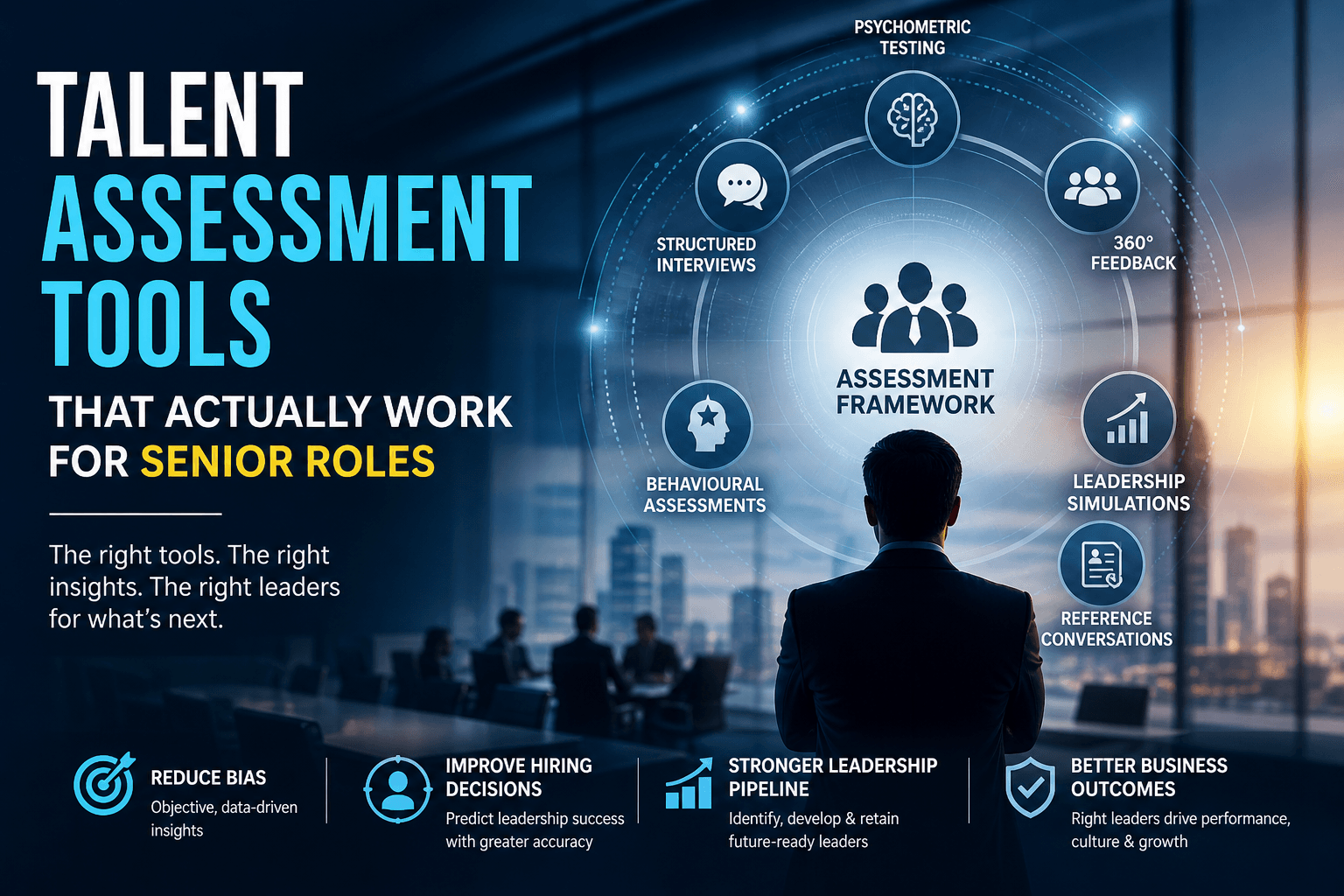
The most effective talent assessment tools for senior roles combine psychometric testing, structured behavioural interviews, 360-degree feedback, and contextual reference conversations — no single tool is sufficient. This guide covers which tools work at the C-suite level, which are overused at that level, and how to build an assessment architecture that produces genuinely useful insights rather than reassuring data.

The problem with assessment at the senior level
Why Most Assessment Tools Are Built for a Different Problem
The talent assessment industry has grown enormously over the past decade. Psychometric platforms, AI-powered screening tools, gamified assessments, 360 feedback systems, and predictive analytics engines all promise to take the guesswork out of talent decisions. And for many use cases — high-volume early-career hiring, mid-level role screening, graduate recruitment — they deliver genuine value.
At the senior leadership level, the problem is different in kind, not just degree. You are not trying to predict whether someone can do a job that has a well-defined profile and measurable outputs. You are trying to assess whether someone can lead an organisation — or a significant part of one — through a set of challenges that are incompletely defined, constantly evolving, and deeply contextual.
No algorithm, however sophisticated, can fully assess that. What assessment tools can do — when selected and applied with rigour — is provide structured, evidence-based inputs that reduce the bias and subjectivity in human judgment. The goal is not to replace judgment. It is to make it better.
9% of Indian organisations use AI or data-led tools in C-suite succession decisions — despite 78% having formal succession frameworks
36% of organisations say their potential assessment process is effective — a significant confidence deficit
40–70% executive failure rate within 18 months — most attributable to poor contextual fit assessment, not capability gaps
That 9% figure is particularly striking: the vast majority of Indian organisations have formal succession frameworks — but almost none are using modern assessment tools within them. The result is that succession decisions are being made on the basis of tenure, relationships, and subjective impressions — precisely the inputs that produce the 40–70% executive failure rate.

The tools that work: A Practitioner’s Guide to Assessment Tools for Senior Roles
There is no single assessment tool that is universally superior for senior leadership evaluation. The most effective approach builds a layered architecture — using different tools to assess different dimensions of leadership readiness, and combining the outputs with experienced human judgment.
| Tool | What it assesses | Best used for | Limitations at C-suite level |
| Psychometric assessments (e.g. Hogan, SHL,16PF) | Personality traits, cognitive style, leadership derailers, risk profile | Establishing a personality and cognitive baseline; identifying potential blind spots and derailers | Measures tendencies, not demonstrated behaviour. It can be skewed by sophisticated candidates familiar with the process. |
| Structured behavioural interviews | Past behaviour in high-stakes situations — the most predictive indicator of future behaviour | Core of any senior assessment; reveals how a candidate actually leads under pressure, not how they describe leadership in the abstract | Quality entirely dependent on the assessor’s ability to probe effectively. Requires trained interviewers. |
| 360-degree feedback | How the individual is perceived by those above, below, and alongside them | Internal candidates; revealing the gap between self-perception and observed behaviour | Susceptible to relationship bias. Less reliable for external candidates with no internal reference network. |
| Case-based / in-tray exercises | Decision-making under pressure; strategic reasoning; prioritisation | Assessment centres; evaluating how candidates process complex, ambiguous business situations | Senior candidates often find them patronising. Validity at C-suite level is debated. |
| Structured reference conversations | Observed behaviour from people who have worked closely with the candidate | Final-stage validation; the most reliable source of contextual fit data available | Quality entirely dependent on how the conversations are structured. Box-ticking reference checks add no value. |
| AI-powered predictive analytics | Pattern recognition across large behavioural datasets; predicting performance probability | Large-scale internal talent identification; screening large candidate pools early in the process | Limited validated data at senior level. Algorithms trained on past success profiles may embed historical bias. |
The CORNERSTONE India approach
How to Build an Assessment Architecture That Works for C-Suite Roles
In our experience across hundreds of senior leadership assessments in India, the organisations that make the best executive appointments do not pick the best single tool. They build an assessment architecture — a deliberate sequence of lenses that, together, reduce the blind spots that any single lens creates.
1. Start with the brief, not the tool
The most common assessment error is selecting tools before defining what you are trying to assess. Every C-suite role has a specific set of demands — strategic, relational, cultural, and operational — that vary significantly by organisation, sector, and growth stage. The assessment architecture should be designed around those specific demands, not around the tools your HR team is most familiar with. The brief defines the dimensions; the tools measure them.
2. Use psychometrics to frame the conversation — not conclude it
Hogan, SHL, and similar tools are valuable at the senior level precisely because they are excellent at identifying potential derailers — the personality characteristics that tend to produce problems under pressure or at scale. A candidate who tests as highly risk-averse in a role that requires bold capital allocation decisions is worth exploring in depth. But the psychometric finding is the beginning of the assessment conversation, not the end of it. Never make a C-suite decision on psychometric data alone.
3. Make behavioural interviews the centrepiece
The behavioural interview — structured around the specific leadership demands of the role and probing for concrete, verifiable examples of past behaviour — remains the single most predictive assessment tool available for senior roles. “Tell me about a time when you had to make a significant strategic decision with incomplete information” produces more useful data than any psychometric instrument. The quality of the questions, and the ability to probe beneath the polished response, is what determine the quality of the insight.
4. Run structured reference conversations — not reference checks
The distinction matters. A reference check confirms that the candidate held the role they said they held and did not commit fraud. A structured reference conversation — conducted with three to five people who have worked closely with the candidate, using a consistent framework of probing questions, and covering specific moments of adversity — is a genuinely powerful assessment tool. It is the one source of data that is almost impossible for a candidate to control, and it is systematically underused at the senior level in India.
5. Assess contextual fit explicitly — it is where most failures originate
The 40–70% executive failure rate is not primarily a capability failure. It is a context failure. Most executives who fail in senior roles are objectively talented people placed in an environment — a culture, a governance structure, a founder dynamic, a stakeholder landscape — that they were not suited to navigate. Contextual fit assessment is the most neglected dimension of senior evaluation, and it requires explicit attention: structured conversations about the candidate’s comfort with ambiguity, their experience of founder dynamics, their operating style in politically complex environments, and their track record in cultures similar to yours.
A note on AI assessment tools at the C-suite level
AI-powered assessment platforms are genuinely useful for high-volume, early-career hiring. At the C-suite level, their application is more limited — and the risks are underappreciated. Algorithms trained on historical leadership success profiles may embed the demographic and contextual biases of the past. Only 9% of Indian organisations use AI in C-suite succession decisions (Deloitte India, 2025), and in our view, this is appropriate caution rather than a gap to close urgently. The human judgment of an experienced assessor, operating within a structured framework, remains superior to algorithmic prediction for the most complex leadership roles.

Talent Assessment for Senior Roles — India-Specific Considerations
The cultural performance effect. Many Indian senior leaders are extraordinarily skilled at performing well in formal assessment settings — particularly structured interviews. The educational system, competitive examination culture, and hierarchical corporate environment have produced a generation of executives who know how to present themselves effectively. The implication for assessment is that surface-level interviews are particularly unreliable in the Indian context. Going deeper — pushing for specific examples, probing for moments of failure and recovery, asking about decisions that did not work out — is essential to reach the layer below the polished presentation.
The relationship between assessment and trust in family businesses. In promoter-led and family-owned organisations, the idea of subjecting leadership candidates — particularly family members — to formal psychometric assessment can feel culturally uncomfortable. In our experience, the most effective approach is to frame assessment not as an evaluation of the individual, but as a collaborative tool to understand how to set them up for success in the role. This reframing — from judgment to enablement — significantly increases the quality of engagement with the assessment process.
Language and regional calibration. Standard psychometric instruments are validated on Western, English-language populations. Their application in India — where leadership operates across multiple languages, regional cultures, and social contexts — requires careful calibration. Assessment tools should be selected and interpreted with this in mind, and conclusions drawn from them should always be validated against observed behaviour in the Indian context, not applied directly from the instrument’s global norms.
“The best assessment architecture we have built at the C-suite level in India uses five tools. The most important one has no vendor, no platform, and no algorithm. It is the ability to ask the right question — and to really listen to what comes back.”
Conclusion
The Best Assessment Architecture Is the One That Reduces Bias Without Replacing Judgment
India’s organisations are at an inflection point in talent assessment. Formal succession frameworks are increasingly in place — 78% of organisations now have them. But the assessment tools and processes operating within those frameworks are not yet producing the quality of insight they should. With only 36% of organisations confident in their potential assessment process, and executive failure rates that remain stubbornly high, the gap between having a process and having an effective process is wide.
Closing that gap at the C-suite level does not require the most sophisticated AI platform or the largest psychometric database. It requires a clear brief, a layered assessment architecture, the discipline to run structured reference conversations, and — above all — assessors with the experience to interpret what they observe in the specific context of Indian business.
CORNERSTONE India’s assessment practice is built on exactly this foundation. If you are making a senior leadership appointment and want to be genuinely confident in the quality of your assessment process, we would welcome the conversation.
