

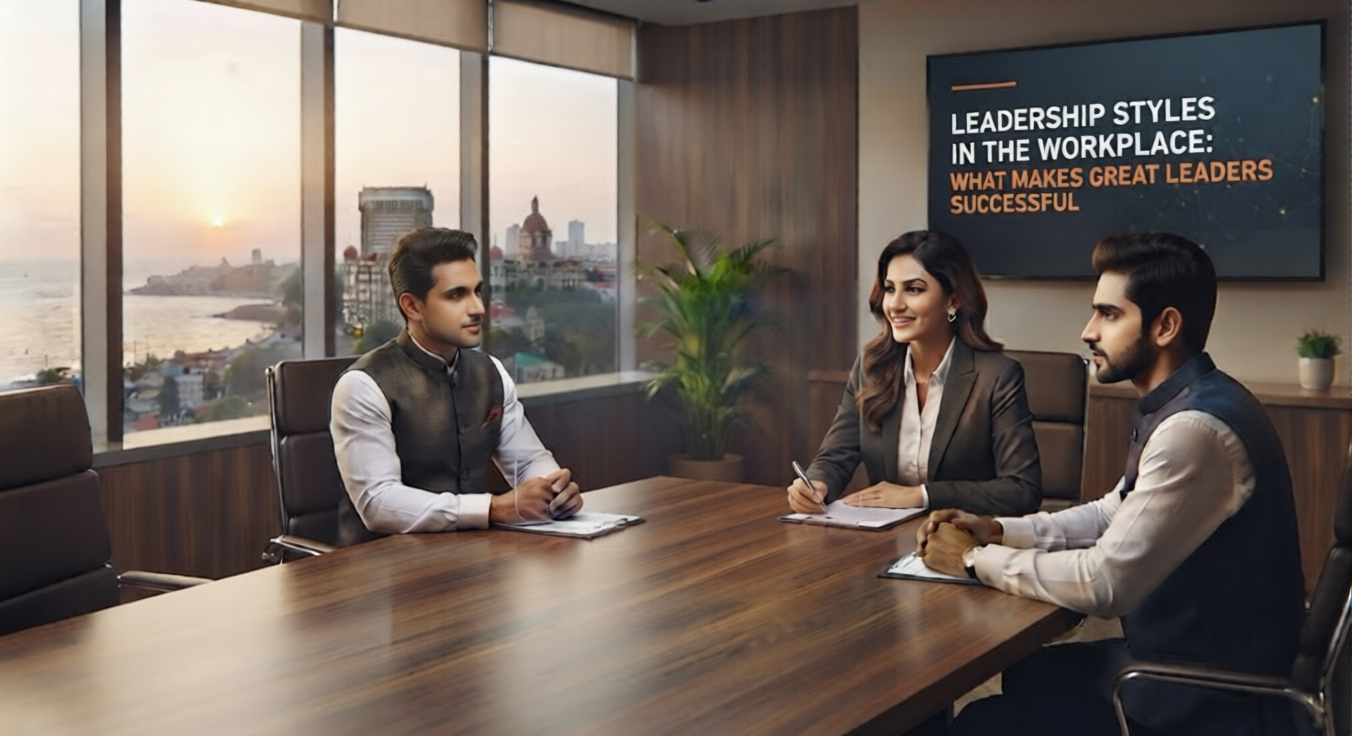
20 Jul : Leadership Styles in the Workplace: What Makes Great Leaders Successful

Leadership styles in the workplace decide more outcomes than most boardrooms give them credit for — I have watched the same P&L target hit by two leaders with completely different results six months later, purely because of how they led, not what they knew. After twenty-plus years of placing and advising CXOs across manufacturing, BFSI, and technology, I have stopped asking candidates what they have achieved. I ask them how they got their teams to achieve it. That question tells me nearly everything about whether an appointment will succeed. Over the years, I have also seen how executive coaching services help senior leaders become more adaptable, improve decision-making, and build stronger leadership capabilities alongside the right hiring decisions.
A few years ago, we placed a CFO with an outstanding financial track record on the board of a mid-sized manufacturing group. Six months in, the client called — not about the numbers, which were fine, but about attrition on his own team, which had tripled. He was a brilliant technician and an autocratic leader in a business that needed collaboration to scale. The mismatch wasn’t competence. It was style. That case has stayed with me, and it is the reason I now spend as much time in an executive search assignment assessing leadership style fit as I do assessing capability. This is exactly why many organisations combine executive coaching services with executive search to ensure newly appointed leaders succeed beyond their first year.
What This Blog Covers
- The six core leadership styles — and when each actually works
- Why style, not title, drives engagement and retention
- What Gallup and SHRM data reveal about style mismatches at senior levels
- How effective leaders shift style deliberately, not by habit
- How style must evolve as leaders move into senior roles
- What works best for Indian enterprise and CXO contexts
What Are the Main Leadership Styles in the Workplace?
The main leadership styles in the workplace are autocratic, democratic, transformational, transactional, laissez-faire, and servant leadership, each defined by how much control a leader retains and how decisions get made.
1. Autocratic: the leader retains control and expects compliance — effective in crisis or safety-critical settings, corrosive when used as a default.
2. Democratic: the leader seeks input and builds consensus before deciding — slower, but tends to produce stronger buy-in.
3. Transformational: the leader sets a compelling vision and invests in people’s growth to get there.
4. Transactional: the leader manages through clear targets, rewards, and consequences.
5. Laissez-faire: the leader steps back and gives the team autonomy — works only with highly skilled, self-directed teams.
6. Servant: the leader prioritises the team’s development and removes obstacles ahead of their own visibility.
None of these is universally “right.” I have placed autocratic leaders who were exactly what a turnaround situation needed, and I have seen transformational leaders fail in businesses that needed operational discipline more than vision. The skill is matching style to context, not defaulting to whichever style feels most comfortable. Organisations that invest in executive coaching services often see leaders develop the flexibility required to shift between leadership styles as business situations evolve.
Framework adapted from leadership style research, Teamflect (2026).
Why Does Leadership Style Matter More Than Leadership Title?
Leadership style matters more than title because it is the daily, lived experience employees have of being managed — and that experience, repeated over months, is what determines whether people stay, contribute, or quietly disengage. Gallup’s research puts a number on this: the impact of leadership and management accounts for roughly 70% of the variance in employee engagement scores across a business.
I see the same pattern from the search side. When a client asks us to replace a CXO, the stated reason is almost always strategic — “we need someone with more digital experience” or “we need stronger P&L ownership.” The real reason, once we dig in with the CHRO or CEO, is very often a leadership style that stopped working for the team underneath it. Capability got the person the seat. Style decided how long they kept it.
Source: Gallup, cited in Teamflect (2026), Leadership Styles 2026 report.
How Do Leadership Styles Shape Organisational Culture and Retention?
Leadership style shapes organisational culture and retention directly, because employees experience culture primarily through their immediate manager’s behaviour, not through a values poster in the lobby. SHRM data shows that 57% of employees who quit a job cite their manager as the primary reason, and organisations that train leaders across multiple styles rather than one default approach see meaningfully higher three-year retention.
I have sat in enough exit conversations, as an advisor rather than the employer, to know this is not an HR talking point. It is the single most common root cause we uncover when a client asks us to understand why a strong-performing team is quietly emptying out. The leader is usually still delivering their numbers. The team, meanwhile, is voting with its feet.
Source: SHRM (2026), cited in Teamflect Leadership Styles 2026 report; Global Leadership Forecast, DDI.
This is also where Gallup’s 2026 State of the Global Workplace data adds a layer most leadership conversations miss: leaders themselves are carrying more stress, anger, and loneliness than the people they manage, even as they report high engagement. A leader operating from that place tends to default to whichever style feels safest — usually more control, less collaboration — which is precisely the wrong direction for retention. Style under pressure reverts to habit, not to what the team needs.
Source: Gallup (2026), State of the Global Workplace: 2026 Report.
What Makes a Leadership Style Effective in Today’s Workplace?
An effective leadership style today is one the leader can consciously adapt to the situation, rather than a single fixed approach applied regardless of context. The most versatile leaders I have assessed move between styles deliberately: more directive during a crisis or a compliance-heavy decision, more democratic when innovation or buy-in matters more than speed, more transformational when a team needs a reason to commit beyond the paycheque.
A scenario from the search desk
A retail client once asked us for a “visionary” CEO. What the business actually needed for its first eighteen months was someone transactional — clear targets, tight cost discipline, consistent follow-through — before any transformation conversation could land. We pushed back on the brief, and the client eventually agreed to sequence the hire that way. The leader they appointed knew exactly when to shift from transactional discipline to a more transformational pitch once the basics were stable. That sequencing, not charisma, is what effectiveness looks like in practice.
How Should Leaders Adapt Their Style as They Grow Into Senior Roles?
Leaders should adapt their style as they grow into senior roles by consciously widening their range, because the behaviours that got someone promoted — often a strong individual command of detail — are rarely the behaviours that scale a larger team. This is the single most common derailment pattern I see in C-suite transitions, and it shows up in several recognisable ways: leaders who cannot let go of control and slide into micromanagement, leaders whose personality quietly reshapes an entire function’s culture without anyone naming it, and leaders who repeat avoidable mistakes because no one around them is honest enough to flag them early.
It is also why executive coaching services has become a standard part of how we support placements at the CXO level, not an optional add-on. A leader’s technical brief rarely changes much between roles. Their leadership style is exactly what needs deliberate work as the scope of their role expands. This is where executive coaching services become invaluable, helping senior executives improve self-awareness, communication, stakeholder management, and strategic leadership.
What Leadership Style Works Best for Indian Enterprises and CXOs?
The leadership style that works best for Indian enterprises and CXOs is rarely a single imported model, but a blend that respects hierarchy where it genuinely helps decision speed while building in enough democratic and transformational elements to retain talent that increasingly has global options. I have watched multinational playbooks land awkwardly in Indian family-run and promoter-led businesses precisely because they assumed a flat, fully democratic culture that did not exist on the ground.
The CXOs we place most successfully into Indian enterprises are the ones who read the existing culture accurately in the first ninety days, rather than arriving with a fixed style and asking the organisation to adjust to them. That diagnostic instinct, more than any single leadership framework, is what separates a successful CXO placement from one we are back in the market to replace within eighteen months.
Closing Thought
Leadership style is not a soft attribute we assess after the technical box is ticked. In our experience at Cornerstone International Group India, it is often the deciding factor in whether a leadership appointment succeeds. The organisations that consistently build high-performing leadership teams invest not only in executive search but also in leadership development coaching to help leaders grow, adapt, and deliver long-term business impact.
If you are evaluating leadership capability — your own, or your next senior hire — this is a conversation worth having early, not after the attrition numbers force it.
Frequently Asked Questions
1. What is the most effective leadership style in the workplace?
There is no single most effective style; the strongest leaders adapt between transformational, democratic, and transactional approaches depending on the situation, team maturity, and business stage.
2. What are the four main types of leadership styles?
The four most commonly referenced types are autocratic, democratic, transformational, and laissez-faire, though transactional and servant leadership are widely used additions to this core set.
3. How can I identify my own leadership style?
Look at your default behaviour under pressure rather than your stated preference: whether you tend to take control, seek consensus, coach for growth, or step back is usually clearer during a crisis than during calm periods. 360-degree feedback and executive coaching services are among the most reliable ways to identify and strengthen leadership style.
4. Is transformational leadership always better than transactional leadership?
No. Transformational leadership drives long-term commitment and innovation, but transactional leadership is often more effective for stabilising a team, enforcing compliance, or delivering short-term operational targets. Most senior leaders need both.
5. Why do employees leave managers, not companies?
Because day-to-day experience of work — clarity, recognition, fairness, growth — is delivered by the immediate manager’s leadership style, not by company-level policy. SHRM data shows manager behaviour is the leading reason employees cite for quitting.
6. Can a leadership style change over the course of a career?
Yes, and it typically must. The style that earns someone a promotion into management is rarely sufficient at CXO level, where the scope of influence and the cost of getting it wrong both increase significantly.
7. How does leadership style affect employee engagement?
Leadership and management practices account for roughly 70% of the variance in employee engagement scores, according to Gallup research, making style one of the single largest levers available to any organisation.
8. What role does executive search play in matching leadership style to a role?
A thorough executive search assignment assesses leadership style fit against the specific culture, stage, and challenges of the business — not only technical capability — since style mismatch is one of the most common reasons senior leadership appointments fail within the first two years.
