

09 Apr : How to Spot Future Leaders Within Your Organisation
Succession planning is only as strong as the pipeline behind it. In this series, we have covered CEO succession best practices, diversity in leadership pipelines, and emergency protocols for sudden vacancies. But every one of those conversations assumes something: that you already know who your future leaders are. Most organisations don’t — not because the talent isn’t there, but because they have never built the system to see it clearly. Your next CEO or business unit head is most likely already on your payroll. The challenge is not finding them — it is building the discipline to identify them before someone else does.
Spotting future leaders within your organisation requires separating current performance from leadership potential, using structured assessment frameworks like the 9-box grid, and building deliberate visibility mechanisms for high-potential candidates who are not yet in the line of sight of senior leadership. This guide covers exactly how to do that — with an India-specific lens, often complemented by insights from senior level recruitment consultants india who bring an external perspective to leadership identification.
Why Most Organisations Are Looking for Future Leaders in the Wrong Places
Here is a finding that should give every CHRO and board member pause: in a Korn Ferry survey of talent acquisition professionals, more than a third — 34% — said their organisations were missing high-potential leaders by not looking deep enough. And only 14% felt very confident that the right people were being selected for their high-potential programmes.
The reason is almost always the same. Organisations conflate performance with potential. The employee who consistently exceeds their targets, leads the room in every meeting, and has the most visible relationships with senior leaders gets nominated for the high-potential programme. The employee who is doing quieter, more structurally significant work — developing team members, solving cross-functional problems, thinking two steps ahead — is overlooked.
This is not a small error. When you don’t have a clear way to spot potential, the default is to promote your most productive team member — which is how you end up with the classic Peter Principle: a fantastic engineer becomes a miserable manager, and suddenly both their performance and their team’s morale take a nosedive.
1) 34% of organisations miss high-potential leaders by not looking deep enough in their own talent pool
2) 57% of companies now have a formal process for identifying high-potentials, rising to 72% in larger organisations
3) 44% reported accuracy rate when organisations predict leadership potential — a significant gap in most talent systems
That 44% accuracy rate is the most important number in talent management today. It means that for every two people nominated to a high-potential programme, one of them should not be there — and at least one person who should be there is not. The cost of this misidentification, in wasted development investment and missed succession opportunities, is compounded every year it goes uncorrected.

The distinction that matters: High Performance Is Not the Same as High Potential
This is the foundational insight that every talent identification system must be built on — and the one most frequently ignored in practice.
A high performer excels in their current role. They are reliable, skilled, and consistent. They are valuable. But the capabilities that make someone exceptional in an individual contributor role are often entirely different from the capabilities that make someone exceptional as a leader of others.
In a new leadership role, an employee must move from using their own expertise to delivering through others. That transition — from personal excellence to multiplied excellence — is where most high performers stall. The ability to develop others, make decisions with incomplete information, hold ambiguity without losing direction, and build trust across organisational boundaries: these are the markers of genuine leadership potential, and they are not visible in performance data alone.
“The best future leaders in your organisation are not always the loudest voices in the room. They are the ones who make the room better — who expand the thinking of those around them before they ever hold a title.”

The signals: Seven Behavioural Signals That Identify Future Leaders
Before any formal assessment, these observable behaviours — when seen consistently and in combination — are the most reliable early indicators of leadership potential in an Indian organisational context:
1) They lead without authority: They organise, influence, and drive outcomes in situations where they have no formal power to do so. Teams form around them informally.
2) They ask better questions than their peers: High-potential leaders are characterised by curiosity that goes beyond their domain. They ask about the business, the strategy, the customer — not just their function.
3) They develop others instinctively: They share credit. They coach without being asked. The people around them consistently grow faster than their peers in other teams.
4) They perform differently under pressure: In moments of ambiguity or crisis, they become more focused — not more anxious. They move toward the hard problem, not away from it.
5) They have learning agility: They apply lessons from one domain to another. They seek feedback actively — and their behaviour visibly changes as a result of receiving it.
6) They think in systems, not tasks: They see upstream and downstream consequences of decisions. They spot interdependencies that others miss. They ask “what does this mean for the broader organisation?” not just “what do I need to do?”

The framework: Five Practices That Build a Reliable Internal Leadership Pipeline
1. Implement the 9-box grid — but use it as a conversation tool, not a scoring system
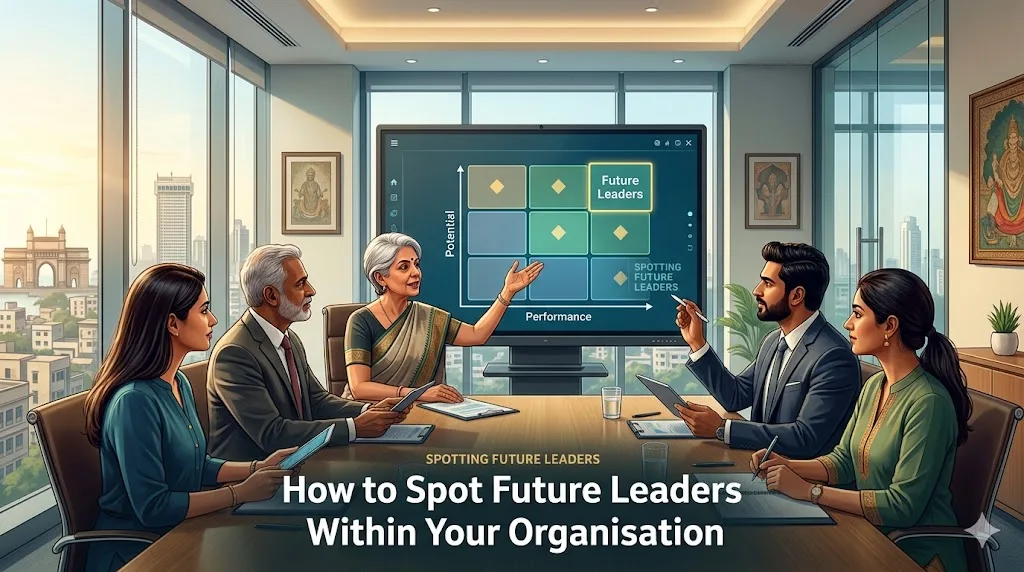
The 9-box grid is a simple but powerful matrix that maps employees on two axes — current performance and future potential. The real value of the 9-box is that it forces a structured, honest conversation about talent, shifting the discussion from gut feelings and subjective opinions to a shared, objective framework. In Indian organisations, where seniority and relationships often dominate talent conversations, this structural discipline is particularly valuable. The 9-box should anchor annual talent reviews at the senior leadership level — not be completed once and filed.
2. Give high-potential employees stretch assignments with genuine stakes
Potential is only visible under pressure. An employee rotated through three departments in a carefully managed development programme will show you something. An employee given a genuinely difficult cross-functional challenge — one where the outcome matters to the business — will show you far more. The most reliable way to assess leadership potential is to create conditions where it can be demonstrated. P&L exposure, crisis ownership, and cross-functional leadership assignments are the proving grounds that development programmes cannot replicate.
3. Build structured sponsorship — not just mentorship
Mentorship gives a high-potential employee advice. Sponsorship gives them access. The distinction is significant. A sponsor is a senior leader who advocates for a high-potential employee in rooms they are not yet in — who puts their own credibility behind the individual’s advancement. In India’s relationship-driven corporate culture, sponsorship is particularly powerful. Without it, high-potential employees who lack natural visibility — including women, employees from non-metro backgrounds, and those in enabling functions — remain invisible to decision-makers until it is too late.
4. Create board and senior leadership visibility for identified successors
One of the most underutilised development levers in Indian organisations is direct board exposure for high-potential talent. Presenting to the board, participating in strategy sessions, and building direct relationships with independent directors are experiences that develop genuine executive-level thinking — and create the familiarity that boards need to make confident succession decisions. This is not about creating a performance stage. It is about building the relational infrastructure for a future transition.
5. Supplement internal observation with external benchmarking
Every internal talent assessment is subject to the perceptual biases of the people conducting it. The most effective organisations combine internal talent reviews with periodic external benchmarking — understanding how their identified high-potentials compare to leaders at a similar stage in peer organisations. This external reference point validates or challenges internal nominations, and often surfaces the calibration errors that accumulate when talent is only ever assessed against internal norms.

Spotting Future Leaders in the Indian Context — What’s Different
The visibility bias is amplified. In Indian organisations — particularly those with strong hierarchical cultures — the employees most visible to senior leaders are often those with the most comfort in formal, top-down interactions. High-potential employees who lead through influence, build distributed relationships, and work at the intersections of functions may be entirely invisible to the leadership team that determines who enters the succession pool. Structured identification processes that include peer nominations, 360 feedback, and cross-functional observation are not optional in this context — they are the mechanism that corrects for the visibility bias.
The metro talent assumption. India’s EY 2025 Work Reimagined Survey shows India leading GenAI adoption at 88% of employees — but the insight relevant here is geographic: the ET HR Trends Report 2025 found that hiring in smaller cities jumped 21% year-on-year, overtaking metro hiring for the first time. Organisations whose leadership identification processes are centred on Delhi, Mumbai, and Bangalore are systematically missing a generation of future leaders with deep market understanding, genuine customer proximity, and lower attrition risk. Expanding the aperture of talent identification beyond the metros is no longer aspirational — it is strategically necessary.
Family dynamics in promoter-led businesses. In family-owned and promoter-driven organisations, the question of who the “future leaders” are is often partially answered before the process begins. The challenge is to ensure that the identification process — even when family members are among the candidates — is structured enough to distinguish genuine potential from relationship proximity. The cost of promoting the wrong family member to a leadership role is not just operational. It is cultural, relational, and often generational.
“In India, the most valuable future leaders are often the ones least likely to advocate for themselves. Building the system to find them — rather than waiting for them to surface — is the difference between a succession pipeline and a succession aspiration.”

Conclusion
Your Next Leader Is Already in the Building. The Question Is Whether You Can See Them.
The organisations that build the most durable leadership pipelines are not those with the most generous development budgets. They are the ones with the most rigorous, honest, and systematic processes for looking at the talent they already have — and seeing it clearly.
In India’s current talent environment — where C-suite mobility is accelerating, the war for experienced external leadership is intensifying, and the cost of an unplanned leadership vacancy has never been higher — the internal pipeline is not a fallback option. It is the primary strategy. The organisations that invest in it deliberately, and the boards that take ownership of it seriously, will be the ones that navigate the next decade of leadership transition with confidence rather than crisis.
CORNERSTONE India supports organisations at every stage of internal talent identification — from designing the frameworks and assessment processes to running structured calibration reviews and benchmarking internal candidates against the external market. If you are ready to look more systematically at the leadership potential, we would welcome the conversation.
Want to build a leadership pipeline that actually works? Let’s connect.
