

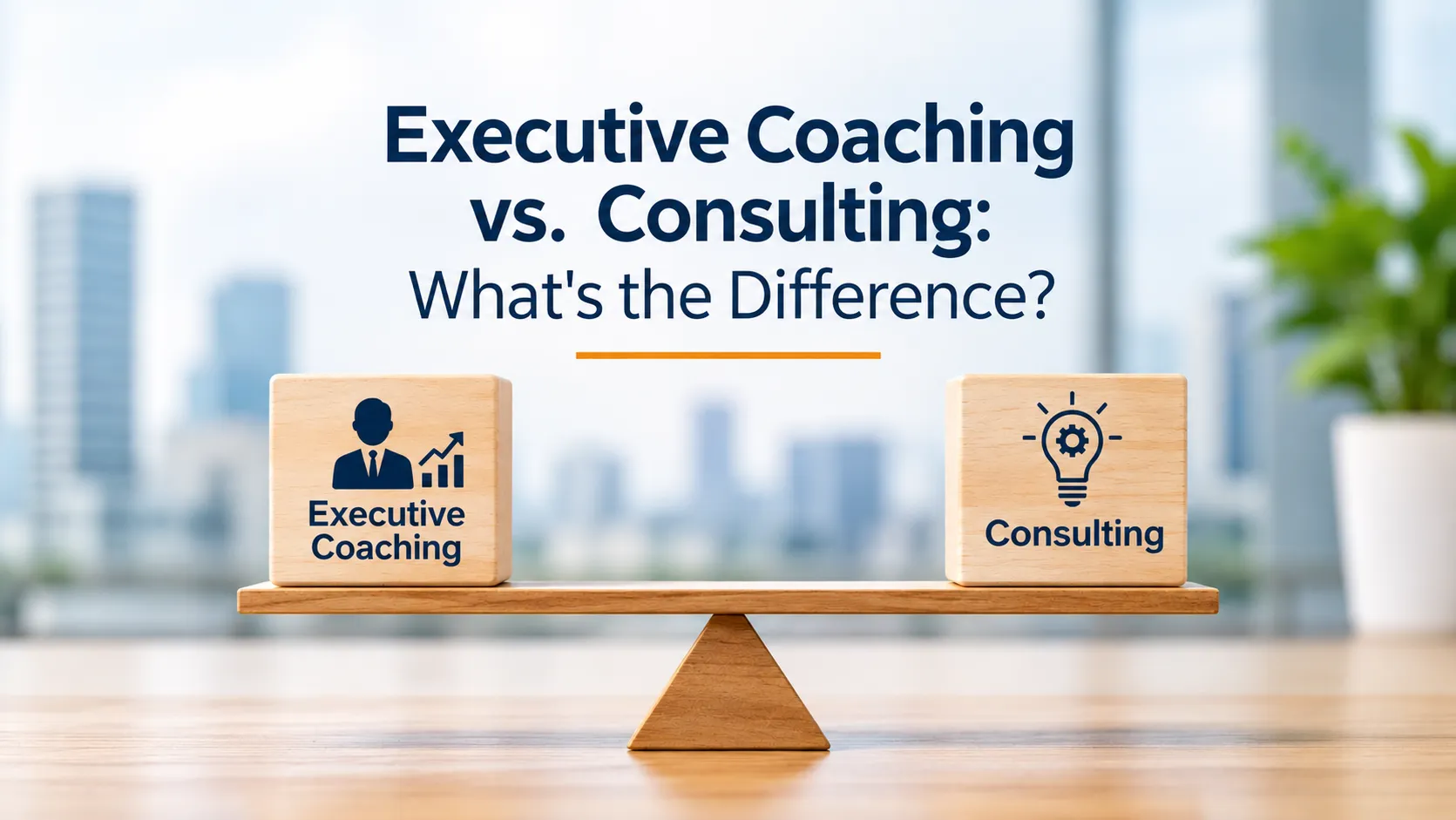
25 Nov : Executive Coaching vs. Consulting: What’s the Difference?

A CEO once told me she had spent a year with an “executive coach” and come away with an excellent operating model for her business. Impressive work. Just not coaching.
That mix-up is common, and it is expensive. Coaching and consulting both put an experienced outsider in front of a senior leader, but they exist to do opposite things. One hands you answers. The other builds the leader who can find them. Pick the wrong one and nothing breaks loudly. You simply get something you never needed.
Here is how I explain the difference.
What is the difference between executive coaching and consulting?
Consulting transfers expertise to solve a business problem. Executive coaching services develops the leader so they can solve problems themselves.
A consultant brings answers: a diagnosis, a framework, a recommendation, often a deliverable. A coach brings questions: a structured way for the leader to examine how they think, decide and lead, and then to change.
In a sentence: a consultant tells you what to do. A coach helps you become the kind of leader who does it well.
Side by side
Executive coaching | Consulting | |
Core question | How do I need to lead differently? | What should the organisation do? |
Focus | The leader | The business problem |
Source of answers | The leader’s own thinking | The consultant’s expertise |
Output | Changed behaviour and judgement | Analysis, recommendations, plans |
Relationship | Confidential, one-to-one | Project-based, team-facing |
Typical duration | 6 to 12 months | Defined by project scope |
Success looks like | A stronger leader | A solved problem |
Where the two overlap
The line blurs at the edges, which is why people mix them up.
Some coaches have deep business experience and will occasionally share a view or a pattern they have seen. Some consultants use coaching techniques with client teams. And good coaching conversations often surface business issues that need a consulting solution.
The test is intent. If the main purpose of the engagement is to change how the leader operates, it is coaching. If the main purpose is to produce a business answer, it is consulting.
When you need a coach
Coaching fits when the problem sits in the leader, not the spreadsheet. In my experience, that means:
- A first-time CEO or CXO adjusting to a seat with no precedent in their career and exploring executive coaching India..
- A leader whose style is limiting the team around them: micromanaging, avoiding conflict, slow to delegate, often benefiting from leadership development coaching.
- A senior executive preparing for a larger role, who needs to think and behave at a different altitude.
- A leader facing a high-stakes decision who wants a sounding board with no agenda.
- A succession candidate who has the technical record but needs breadth.
In each case, nothing is wrong with the strategy. The question is whether the leader can carry it.
When you need a consultant
Consulting fits when the organisation lacks a specific capability or answer. Examples:
- Entering a new market and needing a go-to-market plan.
- Redesigning an operating model or organisation structure.
- Running a cost, process or technology transformation.
- Building a talent strategy or assessing leadership bench strength.
The leader may be excellent. The business simply needs expertise it does not have in-house.
When you need both
More often than not, senior leaders need both, at different points.
Take a company restructuring its leadership team. A consultant may design the new structure. A coach then helps the CEO have the hard conversations, reset relationships with long-standing colleagues and lead through the change.
Or a CHRO building a succession plan with an advisory partner while a coach prepares the shortlisted candidates for bigger roles. The two efforts reinforce each other, as long as each is clear about its job.
The mistake is expecting one to substitute for the other.
Five questions to ask before you hire
- Is the problem a gap in the business or a gap in the leader? Be honest. This one question resolves most confusion.
- What does success look like in twelve months? If the answer is a document, you want a consultant. If it is changed behaviour, you want a coach.
- Who owns the answer? If the leader needs to arrive at it themselves, choose coaching.
- Is confidentiality central? Coaching depends on it. Consulting usually does not.
- Is there a defined end point? Projects end when the deliverable is done. Coaching ends when the goals are met.
Why leaders get this wrong
I see three patterns.
Labels are loose. The market uses “coach” and “consultant” interchangeably, and some providers offer a bit of both. Ask exactly what you will receive and how it will be delivered.
Leaders prefer answers. Senior people are used to solving things. Receiving a recommendation feels productive. Being asked difficult questions about their own behaviour feels slower and more personal. Many default to the comfortable option.
Boards want visible deliverables. A strategy deck is easy to show. A leader who now delegates better is harder to evidence, though often more valuable. This is why measuring coaching properly matters.
A note from the executive search side
In my work, I see what happens when this choice is made badly. A newly appointed CEO is given a consultant to “get up to speed” on the business, when what they really need is a space to work out how to lead a team they did not build. Six months in, the business plan is excellent and the leadership team is not aligned.
The reverse also happens: a leader is sent to a coach to fix what is really a structural problem. No amount of self-awareness will fix a badly designed organisation.
Getting the diagnosis right first is cheaper than getting the intervention wrong.
Final thought
The right question is never “coach or consultant?” It is “what is the actual problem?” Answer that honestly and the choice makes itself.
If you are weighing how to support a senior leader through a transition, I am happy to share how we think about it. Connect with me at vijay@cornerstone.co.in to discuss where coaching, advisory and executive search each fit.
Frequently asked questions
Is an executive coach the same as a consultant?
No. A coach develops the leader’s own capability through questioning and accountability. A consultant provides expertise and recommendations to solve a business problem.
Can one person be both a coach and a consultant?
Some can, but for a given engagement the role should be explicit. Mixing the two without saying so confuses expectations and weakens both.
Which is more expensive, coaching or consulting?
It depends on scope. Consulting projects are often priced by deliverable and team size. Coaching is priced by engagement length and seniority. Compare against the outcome you need, not the fee alone.
Should a new CEO hire a coach or a consultant?
Often a coach, for the leadership transition itself, with consulting support only if there is a specific business gap. See what to expect in coaching for first-time CEOs.
