

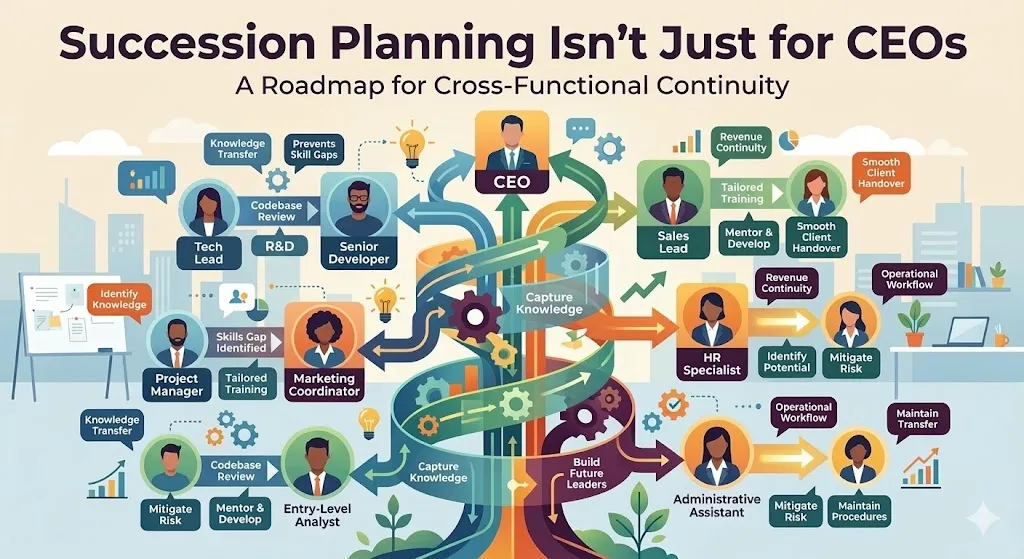
12 Mar Succession Planning Isn’t Just for CEOs. Here’s Why Every Role Needs It
The most dangerous vacancy in your organisation isn’t the one you’re filling today. It’s the one you haven’t planned for yet.
For most organisations, succession planning is a board-level exercise that surfaces once a year — usually when a long-tenured leader signals an exit or an investor asks the question in a review meeting. It is, in practice, a CEO-and-above exercise. Everything below that threshold is left to the reactive machinery of talent acquisition.
This is a strategic miscalculation. And in a market as dynamic as India’s, where talent mobility has accelerated post-pandemic, where the war for mid-senior leadership talent is genuinely fierce, and where institutional knowledge has become a competitive differentiator, it is an increasingly expensive one.
The organisations that are winning the talent game today are not just planning for CEO succession. They are building a living, role-by-role succession architecture that covers every critical position in the business — not as an HR compliance exercise, but as a genuine strategic capability.
The Narrow View and Its Consequences
Ask most boards whether they have a succession plan and the answer will be yes, pointing to a documented process for the MD/CEO and perhaps the CFO. Ask whether they have visibility into succession readiness for their Head of Engineering, Regional Sales Director, or Chief Risk Officer, and the answer is almost invariably no.
The consequences of this blind spot play out predictably. A critical middle-senior leader resigns. The organisation spends three to six months searching externally, paying a search premium, and losing institutional momentum — often discovering in the process that the internal candidates who ‘should have been ready’ were never developed with succession in mind. The cost is not just financial. It is the lost velocity, the team uncertainty, and the cultural signal to high performers that their own development isn’t being actively managed.
At this stage, many organisations also turn to executive search firms in india to access external leadership talent quickly, but relying purely on external hiring without building an internal succession pipeline can become both expensive and strategically limiting.
56% of Indian organisations report at least one critical role vacancy lasting 3+ months in the past year, causing measurable business disruption — Mercer India Talent Trends 2024
Redefining ‘Critical Role’: It’s Not Just Seniority
The first step in building a genuine succession architecture is redefining which roles actually require it. Seniority is a useful proxy, but it is an incomplete one. A critical role is any role whose vacancy would create disproportionate business risk regardless of level.
This typically includes roles that hold unique institutional knowledge, roles that are externally difficult to fill within four months, roles at key inflexion points of the business (the P&L owner of your highest-growth vertical, the technical architect of your core product), and roles where the internal talent market is thin.
In practice, most organisations find that this definition covers significantly more roles than they have succession plans for — often 30–40% of their senior leadership layer and a meaningful portion of the expert-level individual contributor population.
The Four Layers of a Modern Succession Architecture
Layer 1: Role Criticality Mapping
A systematic exercise, ideally conducted annually, that identifies and ranks critical roles by their business impact and external replaceability. This is not a spreadsheet exercise. It requires honest conversations between HR and business leaders about where the real risk sits.
Layer 2: Successor Identification and Readiness Rating
For each critical role, identify internal candidates at three readiness levels: ready now (could step in within 30 days), ready in 12–18 months (with targeted development), and ready in 3+ years (early-pipeline talent). The absence of a ‘ready now’ successor for a critical role is itself a strategic alert that requires action.
Layer 3: Active Development Planning
Succession without development is just a list. The organisation must invest in closing the readiness gaps identified through stretch assignments, executive exposure, mentoring by current role-holders, and targeted capability building. This is where most succession plans stall: the identification is done, but the development never follows.
Layer 4: External Pipeline Awareness
Even the most sophisticated internal succession programme has gaps. A mature succession architecture includes external market intelligence — an awareness, maintained through an executive search partner, of the external talent landscape for critical roles. This does not mean running a live search. It means knowing what the market looks like before you need to enter it at speed.
The India Context: Why This Has Never Mattered More
India’s leadership talent market has undergone a structural shift. The generation of executives who built their careers through a single organisation or sector over 20–25 years is being succeeded by a generation of leaders who change roles every three to five years, who are genuinely global in their optionality, and who are highly attuned to whether their current employer is investing in their growth.
This has two implications for succession planning. First, the average tenure of a critical leader is shorter than it used to be — meaning organisations have less time to prepare successors before they need them. Second, the development experience the organisation provides is now a retention lever. High-potential leaders who can see a clear, actively managed path forward stay longer. Those who can’t will leave for an employer who offers one.
2.8 years average tenure of a senior leader at a mid-to-large Indian company in 2024, down from 4.1 years in 2018 — LinkedIn Workforce Insights India
Getting Boards Engaged: Moving Beyond CEO-Only
One of the most productive shifts a CHRO can make is reframing the succession conversation for the board. Rather than presenting succession as an HR process update, present it as a business risk conversation: here are the five roles where a vacancy in the next 12 months would materially affect our strategic plan. Here is our readiness status for each. Here is what we are doing about the gaps.
This framing immediately elevates the conversation and creates genuine board engagement. It also creates accountability — both for the organisation to act on identified gaps, and for business leaders to take their role in developing successors seriously.
The Actionable Starting Point
For organisations that are starting from a CEO-only succession posture, the practical first step is not to build a comprehensive programme overnight. It is to run a focused critical role audit across the top two leadership layers, produce an honest readiness assessment, and identify the three to five roles where succession risk is highest.
From that starting point, a structured programme built over 12 to 18 months with the right internal investment and external advisory support can meaningfully transform the organisation’s succession posture before the next critical vacancy forces the issue.
Succession planning is not about preparing for someone to leave. It is about ensuring that when they do — as they inevitably will — the organisation barely breaks stride.
Organisations that combine structured succession planning with initiatives like executive coaching services are often better positioned to prepare future leaders internally while maintaining continuity in key roles.
Wondering where your succession risk is concentrated? Connect with us to discuss further.
FAQ's
How many roles should a succession plan typically cover?
Start with any role whose vacancy would disrupt operations for more than 60 days. For most mid-to-large organisations, that’s the top two leadership layers plus key expert roles, typically 10–15 positions to begin with.
What is the difference between succession planning and workforce planning?
Workforce planning addresses headcount and skills at a population level. Succession planning is role-specific — it identifies and prepares named individuals for defined critical positions.
How often should succession plans be reviewed?
Formally, at least annually. But the best organisations treat it as a living process — updating after every significant leadership change, strategy shift, or quarterly talent review.
Is formal succession planning necessary for mid-sized organisations (300–500 employees)?
More so, not less. At this scale, a single critical departure can have outsized impact. A focused audit of your top 8–10 roles with simple successor identification and development plans is high-value and low-bureaucracy.
Who should own succession planning — HR or the business?
Both, with clear lanes. HR owns the process, tools, and cadence. Business leaders own the talent decisions and successor development.
